The GitHub CI Actions for my favorite open-source project, the bookmarking service Shaarli, started failing recently. No one was quite sure why, especially because there hadn’t been any significant updates to the tests, and they passed locally for all the developers who ran them. I had a small pull request that was failing as well, so I thought I would give fixing the actions a shot.
#Coding
-
Debugging GitHub CI Actions
-
The Perl and Raku Conference 2024 - Las Vegas

I was fortunate enough to attend my very first in-person Perl conference this year in Las Vegas! Ironically my first real exposure to Perl was almost 30 years (!!) ago when I read Learning Perl on a plane to Vegas!
It was great to finally meet so many wonderful people that I felt I already knew through using their software and watching conference talks from prior years. Here were the highlights of the conference for me.
-
Changelog/JS Party Podcast on Node.js Notes
Episode 294 of JS Party is titled Reports of Node’s death are greatly exaggerated and features two members of the Node Technical Steering Committee: Matteo Collina and James Snell. Their perspective on the project (and software development in general) was insightful, especially some of the challenges they face.
-
UTC/Local Date Conversion in Perl With Time::Piece
Time::Pieceis my preferred perl module for handling dates. Here is how it can be used to convert between UTC and the local time, even for past dates which may have crossed the current daylight savings time status. -
Regex is a Programming Superpower!
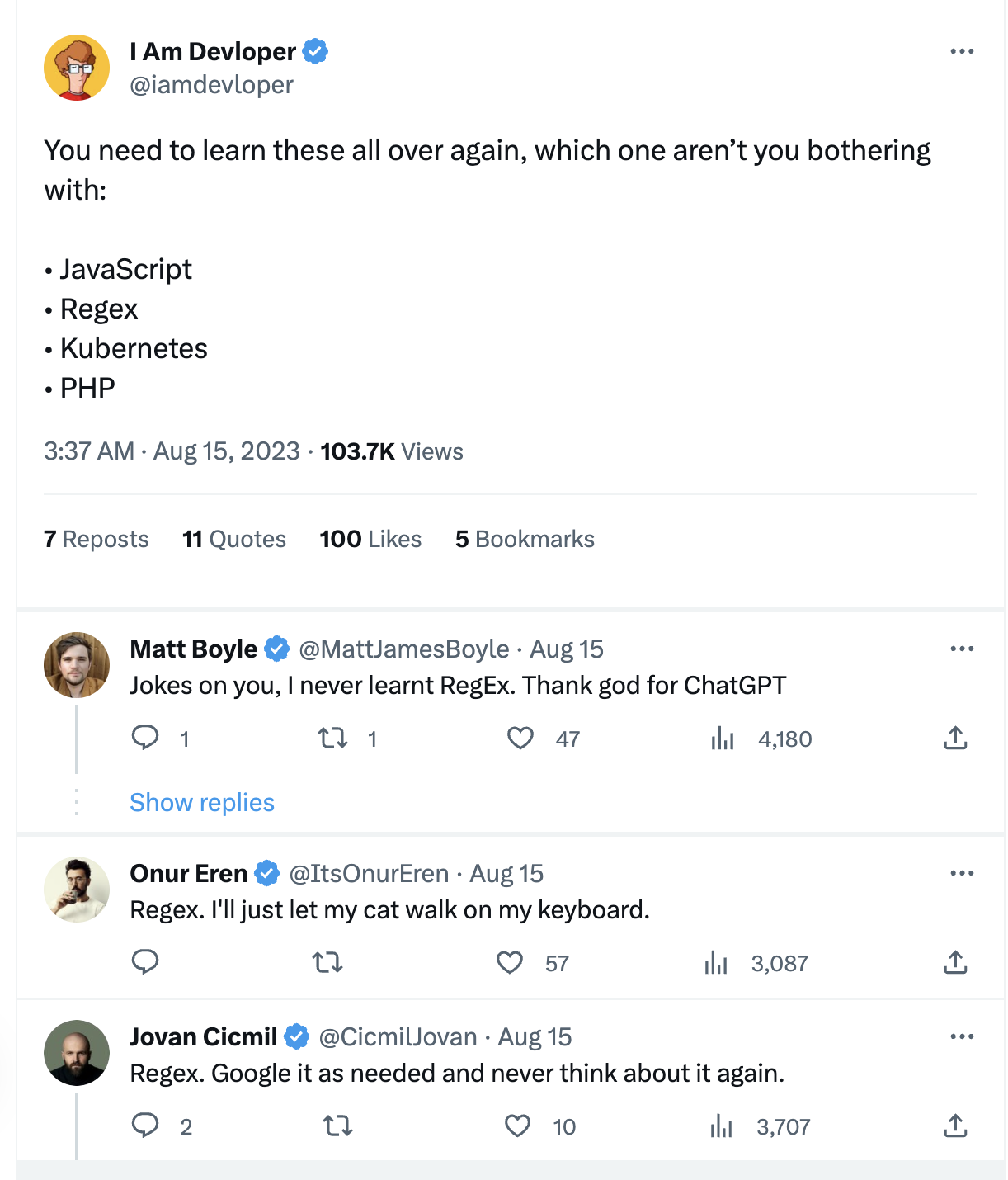
In an August 15 tweet, @iamdevloper, a very funny programmer-humor account, asked which technology you wouldn’t bother to learn over again: JavaScript, Regex, Kubernetes, or PHP. Never mind the completely obvious answer (if you aren’t in operations at Google, you probably don’t need Kubernetes), I was blown away on how many of the responders admitting to not knowing Regex.
-
Using ack to search Apache web logs
The
ackutility uses Perl regular expressions to efficiently search source code, with smart defaults to limit the results to what you expect.One of the ways I use it is to search our Apache web log files. The logs capture all requests, including ones for images, style sheets, fonts, and javascript files. But usually I’m only interested in who visited which web pages, including CGI scripts.
I’ve added a Bash function to my
.bashrcfile,acklog, that filters out the extraneous files automatically:# ack (grep) for scripts in apache function acklog() { ack "$@" | ack -v '\.(css|eot|gif|ico|jpe?g|js|png|svg|swf|webp|woff2?|xml)[? ]' } -
Automatically Updating CVS Revisions Remotely
Our install process involves updating the CVS versions of individual files on the staging and ultimately production servers. Web Operations is responsible for manually updating the files listed on an electronic install form.
After over ten years of this process, I finally realized that we could automate this process, at least for the staging server. A cron script polling a system mailbox every two minutes kicks off the process.
-
Calculating Distances in Microsoft SQL Server
One feature of almost every modern commercial website is the location finder. Enter in a search address, and site displays the closest locations to it with the distances (as the crow flies).
I ran into a couple of peculiar bugs trying to calculate distances in SQL. Floating point math is never easy, and these are the issues I faced using our Microsoft SQL Server database.
-
Installing ODBC on Linux for MSSQL and AS400 DB2
At work, we use Microsoft SQL Server and IBM AS400 databases. Here’s how I set our Linux boxes to allow them to connect to the databases through ODBC. There are seperate instructions for the Debian and Ubuntu (9.10 Karmic Koala) and Red Hat Enterprise Linux (RHEL4 and RHEL5) distributions.
ODBC connections require several layers of software to work. The bottom layer consists of the individual ODBC drivers for each database system. Our top layer is the DBI/DBD interface for Perl. In between these layers is the ODBC driver manager, which keeps track of the DSN’s and their corresponding ODBC drivers.
Packages and Software to Install
Ubuntu Version (tested on 9.10 Karmic Koala)
Debian Version (“unstable” distribution)
We use unixODBC as our ODBC driver manager. First, install unixODBC:
NOTE: Perl’s DBD::ODBC module requires the developer’s version of unixODBC, so install that one.
# apt-get install unixodbc-dev -
Returing null Columns from iSeries AS400 with Perl DBI
We’re having an issue with database queries to the iSeries AS400 through Perl using DBI and DBD::ODBC. The issue occurs when the SQL statement contains an outer join and the query returns rows with NULL columns:
my $sql_query = qq|select PRSK01, PSTA15
                    from TESTHA.POLMAST
                    left join TESTHA.P15POLDP
                    on POLC01 = PPOL15 where POLC01 = 003950136|;

# Execute the sql query
my $sth = $dbh->prepare( $sql_query )
                    or die $sql_query, "<BR>\n", $DBI::errstr;

my $data = $dbh->selectall_arrayref( $sth, {Columns=>{}}, @sql_data )
                    or die $sql_query, "<BR>\n", $sth->errstr;
The error returned is:
DBD::ODBC::db selectall_arrayref failed: st_fetch/SQLFetch (long truncated DBI attribute LongTruncOk not set and/or LongReadLen too small) (SQL-HY000) -
Using jQuery Tablesorter With Dynamic Tables
Here are a couple of tricks to remember when using jQuery’s tablesorter plugin with dynamic tables. These are tables that the user can add or delete from.
-
If the table begins empty (with no rows in
<tbody>), you can’t specify a default sort.If there are no rows in the
<tbody>section when the page is first loaded, the sortList command will crash with a “parsers is undefined” error.
-
-
Notes from the Perl FAQ
Like the fellow that never read his car’s owner’s manual, I had never read the entire Perl FAQ. I finally did it over the holidays, and these are some notes that I took.
-
CVS update error: 'No such file or directoryectory'
When I execute a CVS update command at work, I often get the following error:
[caran@mater safetypublic]$ cvs -q update -AdP
: No such file or directoryectory /home/cvs/safetypublic/rsvp
cvs update: skipping directory rsvp
No such directoryectory? What the heck is that??
-
Calling a Perl CGI script from within another CGI script
Awhile back we had an issue where a coworker wanted to use one of my Perl CGI scripts inside of her scripts, using the backticks method to have it spit its output to the webpage. But for some reason, my script refuse to recognize the arguments she was passing it. The weird thing was, if we ran her script from the command line, everything worked fine.
The issue is in the way CGI.pm detects whether it is being called from a web browser or from the command line. It checks for the presence of the REQUEST_METHOD environmental variable. If it is present, CGI knows to get its arguments from the web browser.
-
Java Terminator: Cross-Platform Terminal Emulator
For years, I’ve been searching for a suitable terminal emulator for Cygwin, but nothing seemed as polished or had enough features to pull me away from the boring default.
I finally found the Holy Grail in a program I’ll call Java Terminator. The authors of this fine program just call it Terminator, but unfortunately a later Linux GNOME-based terminal emulator of the same name stole some of their thunder.
-
Using LWP::Simple to retrieve binary data
We have a Perl CGI script at work that acts as a proxy. It grabs a pkcs12 digital certificate file from an internal server and delivers it to a user through his or her web browser. The pkcs12 file is in binary format.
Everything worked fine until we put the code on a new server. Suddenly, the files downloaded by the web users were corrupted. We also began seeing the following warning in the log files:
Wide character in print at download.cgi line 124.Here is the code…
-
Things I always need to look up in Perl
Here are some random Perl things I always need to look up:
-
Writing an Apache Module for RHEL 5
Recently, I was asked by my employer to write an Apache module. The module reads the requestor’s digital certificate and checks it against our database of active users. In this post, I’ll explain how to get started writing Apache modules, especially for Red Hat Enterprise Linux 5 (RHEL 5.2).
-
Perl Modules Primer
Splitting a Perl application into seperate files can be trickier than doing it in other languages, like C or C++, but it is still an important part of producing maintainable code.